| Concept | Description |
|---|---|
| Big Data Fundamentals | |
| What Is Big Data? | Massive, complex, high-velocity datasets that traditional systems can't handle, requiring advanced storage and processing tools. |
| The 5 Vs | Volume, Velocity, Variety, Veracity, and Value. |
| Applications in Machine Learning | Fuels model training, enables predictive analysis, and supports real-time processing. |
| Tools and Technologies | Storage (Hadoop, S3), processing (Spark, SQL), visualization (Tableau, Power BI), and streaming (Kafka). |
| Big Data in Practice | Precision agriculture, healthcare analytics, retail personalization, and logistics optimization. |
3 Big Data
Big Data refers to massive, complex, and high-velocity datasets that traditional data-processing systems cannot handle effectively. These datasets are characterized by their vast size and require advanced tools, algorithms, and storage mechanisms for processing and analysis. Big Data plays a transformative role in analytics, intelligence, and machine learning by enabling insights that were previously unattainable, and in agriculture, it is the raw material behind precision farming, since a single season of satellite, drone, and IoT sensor readings across a cooperative’s member farms can run to millions of data points.
3.1 Characteristics of Big Data (The 5 Vs)
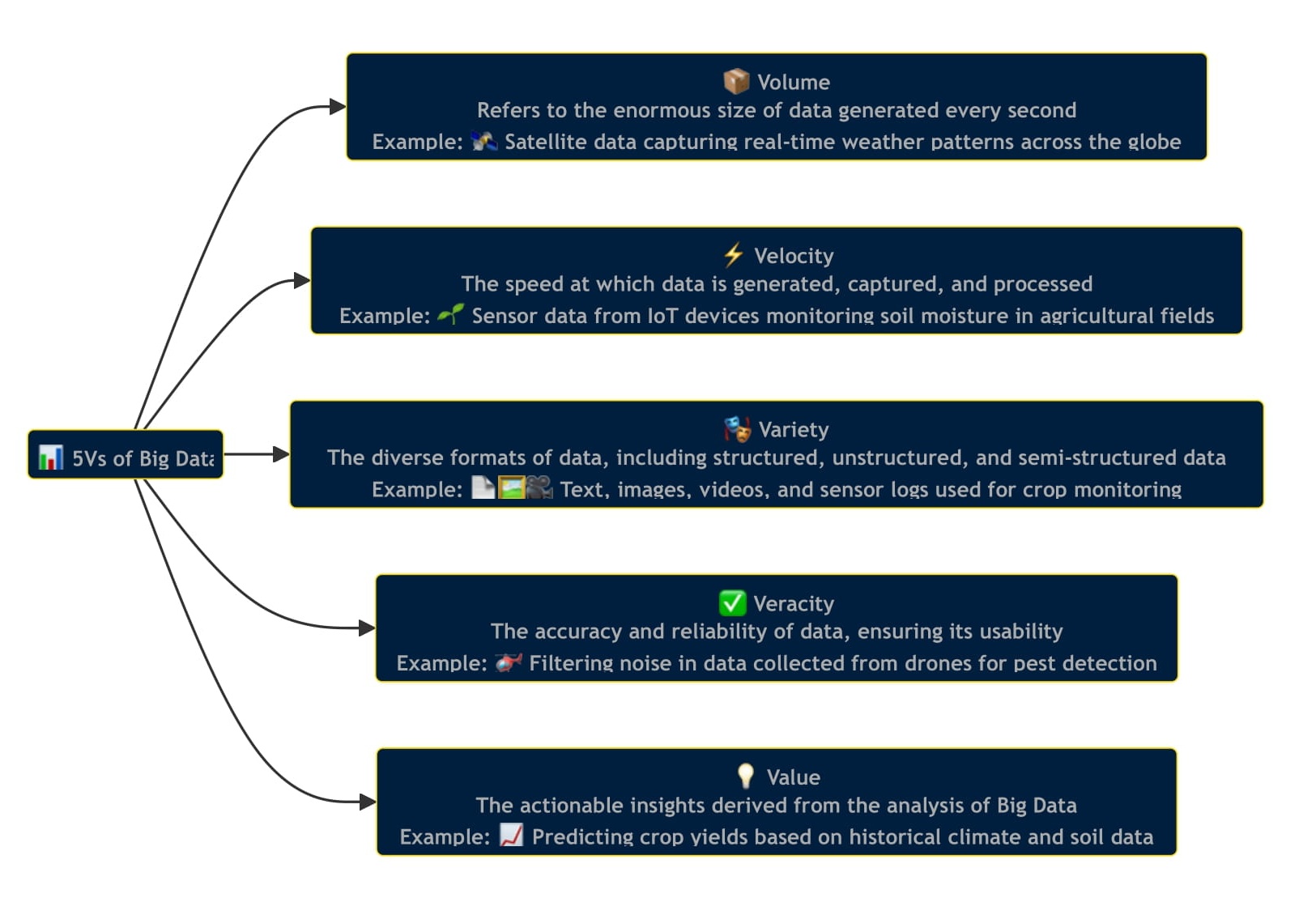
- Volume, the enormous size of data generated every second. Example: satellite data capturing real-time weather patterns across the globe.
- Velocity. The speed at which data is generated, captured, and processed. Example: sensor data from IoT devices monitoring soil moisture in agricultural fields, arriving every few minutes throughout the season.
- Variety, the diverse formats of data, including structured, unstructured, and semi-structured data. Example: text, images, video, and sensor logs, all used together for crop monitoring.
- Veracity, the accuracy and reliability of data, ensuring its usability. Example: filtering noise in data collected from drones for pest detection, where a blurry frame or a shadow can otherwise register as a false positive.
- Value, the actionable insight derived from the analysis of Big Data. Example: predicting crop yields from historical climate and soil data, the point at which volume, velocity, variety, and veracity actually pay off.
3.2 Applications of Big Data in Machine Learning
- Training models. Big Data is the fuel for training machine learning models, improving their accuracy and reliability as more seasons’ worth of data accumulate.
- Predictive analysis. Uses historical data to predict future trends, such as market demand or a pest outbreak.
- Real-time processing. Supports applications that require immediate data processing, such as a fraud-detection system or a live pest-alert feed from field sensors.
3.3 Tools and Technologies for Big Data
| Category | Tools | Typical Role |
|---|---|---|
| Storage and management | Hadoop, Amazon S3 | Distributed, scalable storage for large datasets |
| Processing and analysis | Apache Spark, SQL databases | Fast processing of large volumes; structured-data analysis |
| Visualization | Tableau, Power BI | Interactive dashboards for spotting trends in Big Data |
| Streaming pipelines | Apache Kafka | Real-time data pipelines, e.g. continuous sensor feeds |
3.4 Big Data in Practice
- Agribusiness, monitoring crop health using data from satellites, drones, and IoT sensors, processed at scale with Hadoop and Spark.
- Healthcare, analyzing patient records to identify patterns for early disease detection.
- Retail, understanding customer preferences from purchase history and online behavior.
- Transportation and logistics (optimizing routes using GPS and sensor data through real-time pipelines such as Kafka) the same pattern agribusiness supply chains use to track perishable goods from farm to market.